Festivals, bloom dates & the best spots — south to north
📅 Updated March 2026
🗺 Nationwide coverage
The 2026 Korea cherry blossom festivals are some of the most spectacular spring events in Asia — and this year, the blooms are arriving 3 to 8 days earlier than usual across most of the country. The action starts in late March in the south and winds its way north through mid-April. If you’re planning a spring trip to Korea, this guide covers everything you need: bloom dates by region, the top festivals, and practical tips to catch the peak — from the massive Jinhae Gunhangje to the other spring festivals happening across Korea this season.
🌡 2026 Bloom Update: After a brief cold snap in early March, the Korea Forest Service and KMA now predict a nationwide average peak of April 7. Seoul’s golden window is April 7–12.
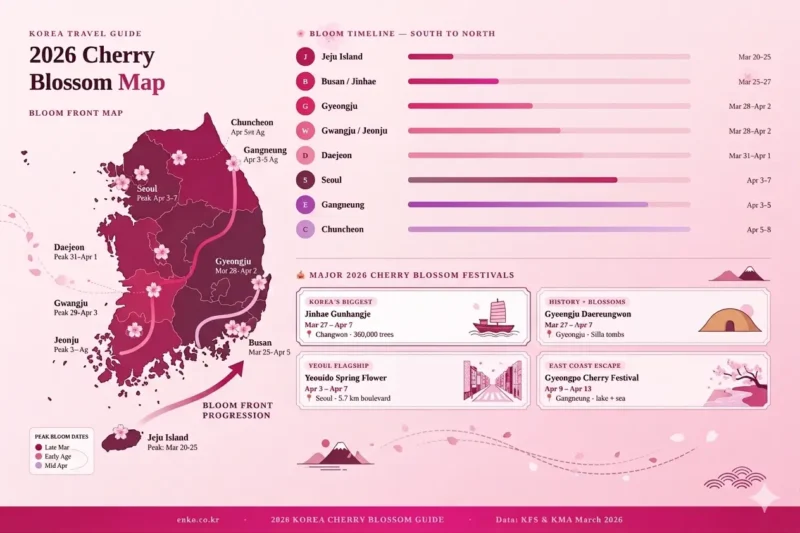
📆 2026 Cherry Blossom Bloom Calendar
Korea’s cherry blossom front travels from south to north over roughly four weeks. The table below shows expected first bloom (when the first flowers open) and peak bloom (when 80%+ of flowers are fully open — the best time to visit).
Region
First Bloom
Peak Bloom
Status
Jeju Island
Mar 20 – 25
Mar 27 – Apr 2
Peak now
Busan
Mar 25
Mar 29 – Apr 2
Peak now
Jinhae / Changwon
Mar 27
Mar 30 – Apr 5
Festival open
Gwangju / Jeonju
Mar 27 – 28
Apr 3 – 7
Opening soon
Gyeongju
Mar 26 – 28
Apr 3 – 5
Opening soon
Daejeon / Cheongju
Mar 31
Apr 5 – 7
Opening soon
Seoul
Apr 3
Apr 7 – 12
Coming up
Suwon / Incheon
Apr 5 – 7
Apr 9 – 13
Coming up
Gangneung (East Coast)
Apr 1
Apr 4 – 11
Coming up
Chuncheon / Gangwon
Apr 8
Apr 11 – 15
Coming up
Source: Korea Forest Service & KMA forecast data, March 2026. Actual dates may shift ±3 days based on weather.
🌸 How the Bloom Front Travels North
Jeju
Mar 20–25
Busan / Jinhae
Mar 25–27
Gyeongju
Mar 26–28
Gwangju / Jeonju
Mar 27–28
Daejeon
Mar 31
Seoul
Apr 3
Gangneung
Apr 1
Chuncheon
Apr 8
🎪 2026 Korea Cherry Blossom Festivals — Top Picks
These are the must-know festivals — organized by region as the bloom front moves north. Each one has a distinct character beyond just the flowers.
The 64th edition of Korea’s most famous cherry blossom festival. The entire city of Jinhae transforms under 360,000 royal cherry trees, drawing over 2 million visitors each year. Unlike other festivals, this one combines blossoms with a naval heritage celebration honoring Admiral Yi Sun-sin.
Cherry blossoms against ancient Silla royal tombs — one of the most photogenic settings in Korea. Stroll the stone-walled Daereungwon paths lined with blooming trees, then continue to Bomun Lake for a lakeside blossom walk.
Seoul’s biggest blossom event takes over a 5.7 km stretch of Yunjung-ro lined with 1,886 royal cherry trees. The road closes to traffic on weekends, turning the boulevard into a pedestrian pink tunnel alongside the Han River.
A 2.5 km loop around Seokchon Lake framed by thousands of cherry trees — and the Lotte World Tower soaring in the background. The nighttime reflection in the lake with illuminated blossoms is genuinely magical.
Gangneung blooms about 5 days after Seoul, giving late travelers a second chance to catch peak flowers. Gyeongpo Lake is ringed with cherry trees, and the nearby East Sea beach adds a coastal freshness that inland festivals can’t match.
Cherry trees + ocean view combo
Gyeongpo Provincial Park loop walk
Day trip from Seoul via KTX (90 min)
🎫 Book a Cherry Blossom Tour
No Korean language skills needed — all tours include English-speaking guides and round-trip transport from Seoul.
⭐ Most popular
Jinhae Gunhangje Festival Day Tour from Seoul
Visit all the key spots — Yeojwacheon Romance Bridge, Gyeonghwa Station railway, and the naval base — on a guided day trip from Seoul. English & Chinese guides available.
Korea King Cherry Blossom Day Tour · Coastal & Temple
See Korea’s giant king cherry blossoms (왕벚꽃) at a scenic coastal location and traditional temple — a different side of blossom season away from the festival crowds.
Can’t decide where to go? This popular blindbox tour takes you to the top 3 bloom spots around Seoul on the day — revealed only on departure. Perfect if you’re flexible.
Whether you’re attending one of the 2026 Korea cherry blossom festivals or exploring independently, timing and preparation make all the difference. Here’s what to know before you go.
🕖
Go early in the morning
Yeouido and Jinhae are mobbed by 10 AM on weekends. Arrive before 8 AM for empty paths, soft light, and the best photos.
📅
Weekdays over weekends
Blossom crowds peak on weekends. If you can visit Tuesday–Thursday, the difference in crowd size is dramatic — especially in Seoul.
🌤
Watch the weather closely
Rain and strong winds can strip the petals within hours. Check the KMA 3-day forecast (weather.go.kr) before finalizing your date.
🚇
Skip driving near festivals
Parking near Jinhae and Yeouido is nearly impossible during peak days. Use public transit, KTX for inter-city travel, or pre-booked shuttle services.
🧥
Layer up for evenings
April daytime temperatures are pleasant (14–18°C) but evenings drop to 6–9°C. A light jacket is essential if you’re staying for night illumination.
📸
Best light for photos
Golden hour at 5–6 PM is ideal. Overcast days give even, soft light without harsh shadows — actually better for blossom photography than bright sunshine.
❓ 2026 Korea Cherry Blossom Festivals — FAQs
When is the best time to see cherry blossoms in Korea in 2026?
It depends on which region you’re visiting. In the south (Jinhae, Busan, Gyeongju), the last week of March through early April is peak season. In Seoul, aim for April 7–12. In the Gangwon region (Chuncheon, Gangneung), mid-April is often still spectacular. If you can only pick one window, late March to early April covers both the major festivals in the south and the very beginning of blooms in Seoul.
Is the Jinhae festival worth the trip from Seoul?
Absolutely, if you plan ahead. Jinhae is about 3.5–4 hours from Seoul by KTX + bus, or you can take a direct tourist bus from Seoul. The scale of the festival — 360,000 trees across an entire city — is something Seoul simply can’t replicate. Book accommodation early (6–8 weeks before) as the Jinhae area sells out quickly. Going mid-week is strongly recommended to avoid the worst of the weekend crowds.
Are Korean cherry blossoms the same as Japanese sakura?
The variety most commonly planted in Korea — the 왕벚나무 (King Cherry, Prunus × yedoensis) — is genetically traced back to Jeju Island, making it technically a Korean-origin tree. The flowers look very similar to Japanese Yoshino cherry blossoms, which are derived from the same base variety. So while the aesthetic experience is similar, Korea’s cherries are their own story.
How long do cherry blossoms last in Korea?
Once in full bloom, peak conditions last about 5–7 days under normal weather. A day of heavy rain or strong wind can cut that short. The entire blossom season at any given location spans about 2–3 weeks. Across the whole country, you have roughly 4 weeks from the first southern blooms to the last mountain blooms in the north.
What’s the best app or website to track real-time bloom status?
The Korea Forest Service runs a bloom tracking page at forest.go.kr (Korean). For English, the Korea Tourism Organization’s english.visitkorea.or.kr publishes regular seasonal updates. On social media, searching #벚꽃 + the city name on Instagram or Naver Blog gives you up-to-the-hour ground-level photos from locals.
Can I see cherry blossoms and Gyeongju in one trip from Seoul?
Yes — this is a popular itinerary. Take the KTX from Seoul to Gyeongju (about 2 hours 10 minutes) during late March or early April. You can add Busan easily (30 min from Gyeongju by train) and catch both the Daereungwon festival and the Jinhae area if timing aligns. A 3–4 day trip from Seoul covering the southeast is very doable.
Looking for More Korea Spring Festivals?
Tulip fields, lantern festivals, mud festivals, and more breathtaking blooms — our full spring guide has it all.
Last updated: March 2026 · Bloom forecast data: Korea Forest Service (KFS) & Korea Meteorological Administration (KMA) · Festival dates sourced from official organizer websites. Dates are subject to change based on actual bloom conditions.