🌱 Gimhae Bongha Village, Where a President Returned to Life as a Citizen



Bongha Village is a small, quiet farming village located in Jinyeong-eup, Gimhae, South Gyeongsang Province.
Yet in modern Korean history, this place is remembered as far more than a hometown.
It is a village where the values of life, politics, and citizenship continue to quietly breathe.


This village is the hometown of Roh Moo-hyun, the late former President of South Korea,
and the place where he returned after leaving office—
choosing to live his final years not as a former head of state, but as an ordinary citizen.
1️⃣ Roh Moo-hyun’s Birthplace — Where Everything Began
At the heart of Bongha Village stands former President Roh’s birthplace.
There is nothing grand about it.
A low-roofed traditional house, a small yard, and an old kitchen—that is all.


Yet this humble home reveals:
the everyday life of a poor farming family,
traces of a boy who loved books,
and the very beginning of a belief in “a world where people truly live.”
This is not so much a memorial as it is a place of origins—
a space where one encounters the starting point of a single human life.
Roh’s life was, quite literally, a series of challenges and hardships.
Born into poverty in Gimhae, he graduated from a commercial high school, worked manual labor jobs, and passed the bar exam through self-study.
That journey alone already tells the story of an outsider—a life lived far from the center.
2️⃣ From the Margins to the Center — Roh Moo-hyun’s Life
🤝 The Birth of a Historic Partnership: The “Roh & Moon” Law Office
After briefly serving as a judge, he moved to Busan in 1978 to open a small law practice. In the early 1980s, he formed a partnership with Moon Jae-in, then a fellow lawyer, and the two established a joint law office. Together, they defended laborers, students, and political dissidents at a time when such work carried significant personal risk.


This period marked Roh’s emergence as a human rights lawyer outside the political mainstream. The cases he handled in Busan—often on behalf of those with little social or legal protection—gradually shaped his public reputation and moral authority.
Entering politics in 1988, Roh faced repeated electoral defeats, largely due to entrenched regionalism. Yet his persistence, forged through loss rather than power, eventually led him to the presidency in 2002. His rise marked the arrival of a leader shaped not by elite institutions, but by the margins of society.
3️⃣ The Democratic Values He Left Behind
At the core of Roh Moo-hyun’s vision of democracy were two principles: de-authoritarianism and participation.
He sought to dismantle the long-standing concentration of presidential power by promoting horizontal leadership and limiting the political use of state institutions. Authority, in his view, was not something to be exercised over citizens, but shared with them.
Equally central was participatory democracy. Roh consistently emphasized that politics should not belong exclusively to elites. His belief in “the organized power of awakened citizens” encouraged public engagement, dialogue, and civic responsibility—values that continue to shape Korea’s democratic culture today.
Roh repeatedly emphasized “the organized power of awakened citizens.”
Politics, he argued, should not belong to elites alone, but to everyone.
This message fueled online political participation and helped lay the groundwork for Korea’s vibrant civil society today.
4️⃣ 🏡 The Home He Returned to After Office
In Bongha Village stands the house where Roh Moo-hyun actually lived after leaving office.
This was not a symbolic residence, but a place of daily life—
where he remained a private individual until the very end.


He chose not Seoul, nor any city, but the rice fields of his hometown.
Low fences allowed the house to blend naturally into village paths and farmland.
It embodied his declaration: “I will live not as a former president, but as a citizen.”
Here, he took walks, read books, greeted neighbors, and welcomed visitors.
This home marks not the end of power, but a conscious choice about how to live.
5️⃣ Practicing “A World Where People Live”
For Roh Moo-hyun, Bongha was not merely a place to return to.
After retirement, he devoted himself to the Hwapo Stream ecological restoration and eco-friendly duck farming.


These were not simple agricultural projects.
They were experiments—testing how democracy, environmental care, and balanced development could be practiced at the village level.
In this way, Bongha Village itself became a classroom for democracy.
6️⃣ Owl Rock and the Burial Site — Where Memory Rests
▪ Owl Rock


Encircling Bongha Village like a natural screen, Owl Rock is the place where Roh Moo-hyun passed away.
It is a site of tragedy, but also one of reflection—
where countless visitors pause to reconsider the meaning of democracy.
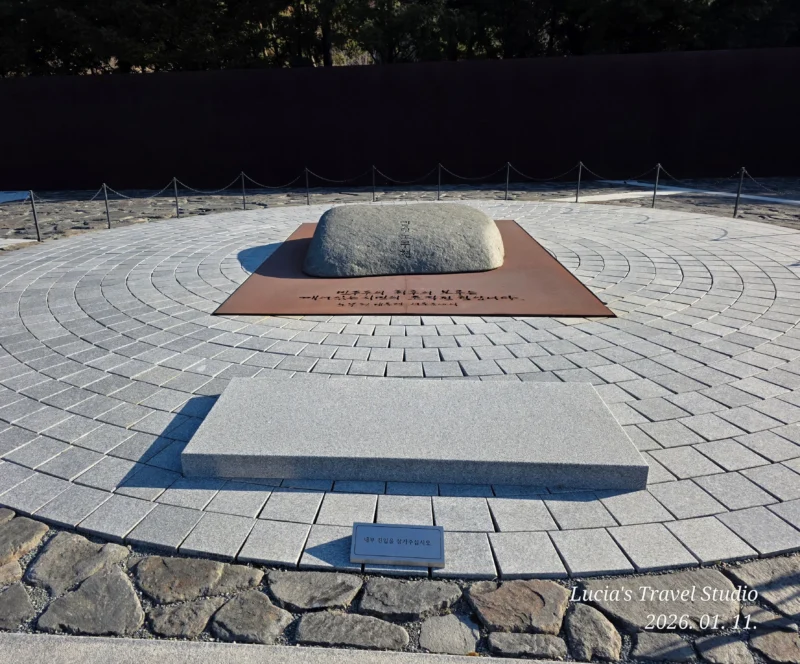
▪ Roh Moo-hyun’s Burial Site
The burial site takes a form rarely seen anywhere in the world.


15,000 stone slabs engraved with messages written by citizens
(“We love you,” “We will not forget,” “Rivers never abandon the sea.”)
A very small headstone, built according to his final wish:
“Leave only a small stone near my home.”The low, flat stone structure symbolizes his desire to remain among citizens, even in death.
This is not the resting place of a single president, but a burial site created collectively by the people.
7️⃣ Roh Moo-hyun in Korean History
Debate over Roh Moo-hyun’s legacy continues, reflecting the challenges he posed to entrenched power.
Yet he is widely remembered as one of Korea’s most human presidents—one who spoke plainly, governed transparently, and accepted political risk in pursuit of principle.
Rather than consolidating authority, he sought to redistribute it.
The democratic seeds he planted—participation, dialogue, and civic dignity—remain active forces in Korean society.
8️⃣ Spaces of Remembrance — Where Memory Becomes Everyday Life
Beyond solemn sites like the birthplace and burial ground,
Bongha Village also offers spaces where one can encounter Roh Moo-hyun more gently—
places where remembrance flows naturally into daily life.
1) A Café in Bongha Village — A Place to Pause
There is one small café in the village.
On cold winter days, it becomes a place to warm your hands—and your heart.
It’s modest and unassuming, but deeply welcoming.
While we sat with a hot drink, the woman behind the counter spoke quietly about her memories of former President Roh Moo-hyun, back when he was still alive. She remembered him not as a symbol, but as a person—how he spoke, how he listened, how the village felt then.


The space was small, but the stories filled it.
And somehow, that warmth lingered long after we stepped back outside.
This café doesn’t try to impress.
It simply stays—gentle, sincere, and beautifully human.
2) Roh Moo-hyun Memorial Hall — A Familiar Way of Remembering
Located across from the residence, the memorial hall feels less like a formal exhibition space
and more like a place to remember “my president.”
a. The Gift Shop — Warm, Familiar Remembrance


The items here do not emphasize authority.
Instead, through gentle phrases and warm designs,
they present Roh Moo-hyun not only as a historical figure,
but as someone familiar—someone close.


It is both a souvenir shop and a space that quietly warms the heart.
b. 2025 Special Exhibition: Su-jibi (守之碑)
In 2025, the Roh Moo-hyun Foundation presented an exhibition titled Su-jibi.
The name refers to the plum blossom, the first flower to bloom after winter.


Just as the plum blossom symbolizes integrity and resilience in hardship,
the exhibition portrayed Roh Moo-hyun’s life through artistic representations of plum flowers.
Like blossoms blooming silently in the cold,
the works reflected his endurance, convictions, and the solitude he bore.


The exhibition reminds us:
Roh Moo-hyun should not be remembered only for a tragic moment,
but as someone who held his ground until the very end.
✨ What These Spaces Mean
These places do not demand mourning.
Instead, they gently weave memory into everyday life.
And when you leave Bongha Village,
what remains is not sorrow,
but quiet respect—and a lasting warmth.
This post is the sixth entry in my six-day winter journey through Gyeongnam and Gyeongbuk—a trip shaped by coastal landscapes, lived-in history, and a slower, more reflective rhythm of travel.
Start of the journey — Sancheong
Namhae (Entries 2–3)
Tongyeong (Entries 4–5)