🍽️ Andong Traditional Food – The Taste of a City That Preserves Time
Andong’s food is not flashy. Instead, it carries something more enduring.
The flavors of this city are shaped not by freshness but by time, not by intensity but by restraint. More than technique, they are shaped by attitude.
🐟 Andong Salted Mackerel

Andong Traditional Food – Salted Mackerel Specialists
A Deep Flavor Crafted by Time and Salt
Andong is one of the cities farthest from the sea. Because of this, its seafood culture chose a different path—one that values time and skill over freshness.
▪ The Art of the Journey
The nearest harbor was Ganggu Port in Yeongdeok. Transporting mackerel from there to Imdong Chatgeori Market in Andong took nearly a full day.
▪ The Magic of Natural Aging
Just before the fish began to spoil, it was heavily salted at the entrance to Andong. As moisture was drawn out, enzymatic reactions began. The flesh became firmer, and the flavor deepened. Locals called this process “natural aging.”
▪ The Hand of the Ganjaebi
The heart of Andong salted mackerel lies in the hands of the ganjaebi—the master who salts the fish. By adjusting the amount of salt according to humidity, the condition of the fish, and the season, they created mackerel that is savory and rich, never fishy.



🏠 Representative Restaurant – Iljik Sikdang
A Second-Generation House of a Master Ganjaebi
The long line outside the restaurant speaks for itself. Both locals and travelers consider this place a must.
The kitchen is led by Lee Jeong-geon, son of the legendary ganjaebi master, the late Lee Dong-sam. Since the 1960s, the family’s philosophy and salting techniques have been preserved for over 20 years without change.
True to its name Iljik (meaning “one straight path”), this restaurant has devoted itself exclusively to salted mackerel.


▪ What Makes It Special
About 5,000 mackerel used each month
Only top-grade mackerel from Jeju
Solar salt aged for over a year
The ability to measure exactly 20g of salt by hand, without a scale
As a result, the flavor is not aggressively salty but deeply nutty and umami-rich.
▪ Signature Dishes
Grilled Salted Mackerel – KRW 15,000
→ Aged for one to two days, then grilled over charcoal for about 10 minutes
→ Crispy skin, moist and juicy flesh

Braised Salted Mackerel – KRW 17,000
→ Made with a whole salted mackerel, not fresh fish
→ Daikon radish is pre-braised in kelp and scallion-root broth for depth
Placed atop a bowl of steamed white rice, one instinctively nods and thinks,
“Yes—this is Andong.”

Andong Traditional Food
ℹ️ Visitor Information
Tel: +82-54-859-6012
Hours: 08:00–21:00 (Last order 20:30)
Closed: Mondays
Takeout available / Parking available
📘 Blue Ribbon Selection, multiple years
🍚 Heotjesabap
A Scholar’s Adorable Little Lie
The name itself is playful. Heotjesabap literally means “a ceremonial meal without a ceremony.” It refers to a meal prepared exactly like ancestral ritual food, even though no ritual was actually held.
▪ The Origin of Heotjesabap
Andong’s Practice of Bongjesajeopbingak (奉祭祀接賓客)
In Andong, deeply rooted in Confucian tradition, honoring ancestors and welcoming guests has long been considered a moral duty. This philosophy is known in head families as bongjesajeopbingak—to serve ancestral rites and receive guests with respect.
Here, ancestral rituals were not merely formalities, but the glue that bound families and communities together.

▪ The Tradition of Eumbok
After a ritual, family members and guests would gather to share the food placed on the ceremonial table. This act is called eumbok, meaning to partake in blessed food.
Leftover ritual dishes were often mixed with rice—vegetables, meat, and jeon all together. Over time, this practice evolved into a full ceremonial meal recreated without an actual ritual, which became Heotjesabap.
▪ Two Stories Behind Its Birth
1️⃣ The Scholar’s Tale
In Andong, home to many Confucian academies, scholars during times of rice scarcity would set up ritual food, compose ceremonial texts, enjoy poetry and conversation, then perform a “mock ritual” and share the food together.
2️⃣ The Commoner’s Tale
Another story says that commoners, unable to hold formal rituals, recreated ceremonial dishes simply to enjoy a bowl of rice, borrowing the form of ritual food for everyday sustenance.
▪ Flavor and Composition
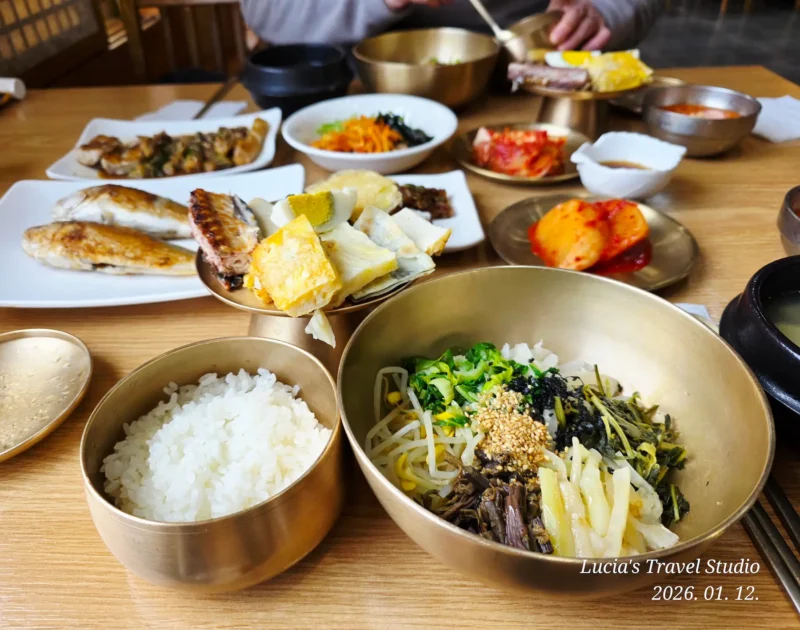
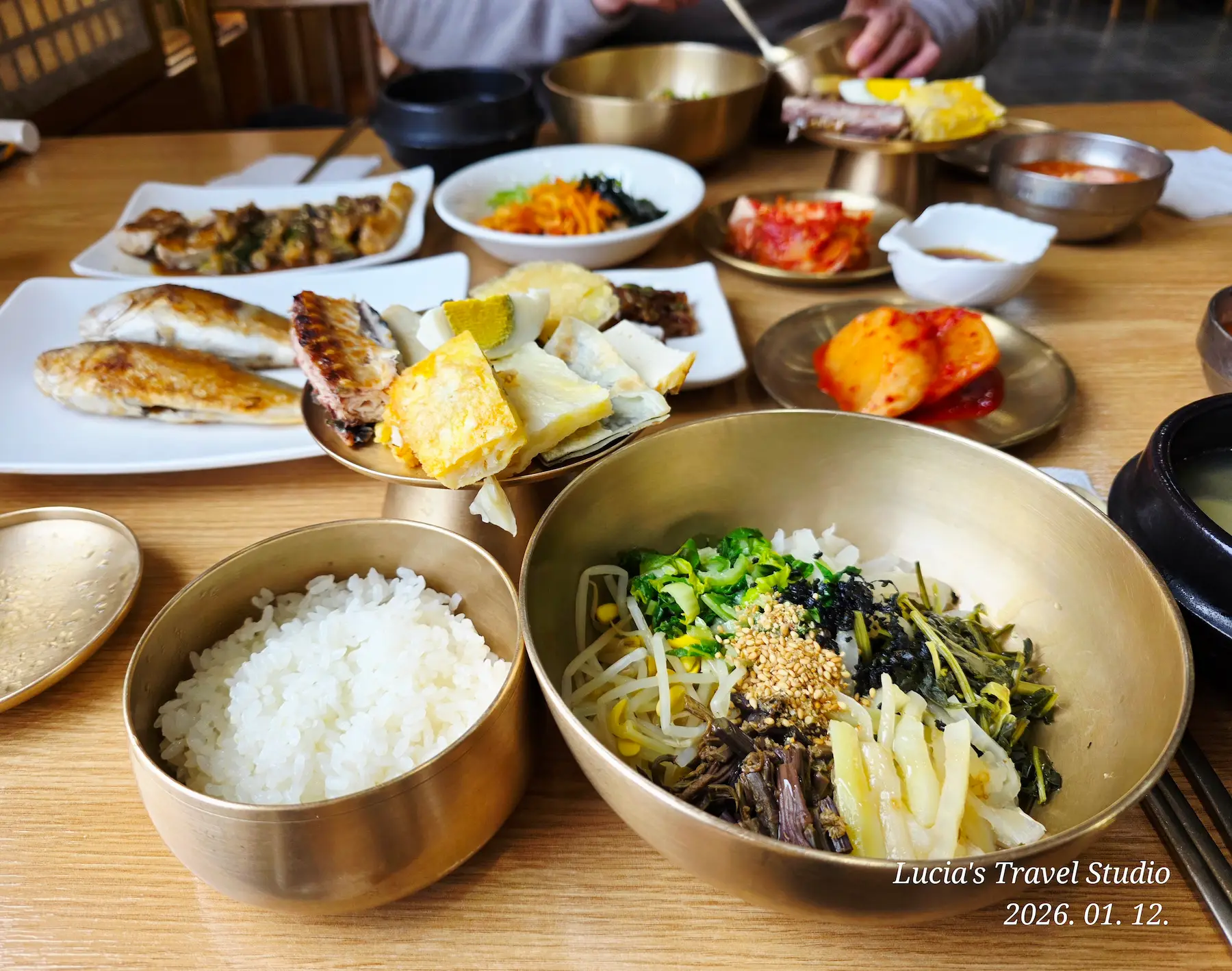
Heotjesabap consists of rice mixed with lightly seasoned vegetables, never using gochujang. Instead, it is flavored with soy sauce and ground sesame, allowing the natural aromas of the ingredients to shine.


It is served with:
- A clear soup with beef and radish
- Namul (seasoned vegetables) on rice for bibimbap
- Assorted jeon and skewers including dombaegi (salted shark meat)
- Various seasoned meat with spring onion
- Fish like yellow croaker
- Tteok (steamed rice cake) for desserts
- Andong Sikhye (a red fermented drink with radish—spicy and tangy) for desserts
The result is a meal that is gentle and restrained, yet deeply satisfying.
▪ Defining Characteristics
No garlic, scallions, or chili powder (oshinchae)
Soy sauce instead of chili paste
Clean, understated flavors rooted in ritual cuisine
Today, Heotjesabap has become a shared cultural dish, free of religious barriers and one of Andong’s most representative food traditions.
🏠 Representative Restaurant – Kkachigumeongjip
Traditional Flavors Across from Woryeonggyo Bridge
A serene hanok exterior, ample parking, and a spacious interior with exposed wooden beams make this restaurant especially popular with families.


▪ Heotjesabap Set Includes
Six seasoned vegetables (fernbrake, bellflower root, radish, etc.)
Soup
8–9 varieties of jeon
Andong sikhye
▪ Menu Highlights

Heotjesabap (with sikhye or red sikhye) – 15,000 KRW
Heotjesabap + Salted Mackerel Set – 22,000 KRW (2-person minimum)
Yangban Table – 25,000 KRW
(Prices subject to change)
Mix the rice with soy sauce, then finish with a refreshing sip of sikhye—a clean, satisfying end to the meal.
ℹ️ Visitor Information
Location: 203 Seokju-ro, Andong-si (across from Woryeonggyo Bridge)
Hours: 09:30–20:30
- No closing days
Parking available / Baby chairs available
📘 Blue Ribbon Selection, multiple years
- Step outside, and Woryeonggyo Bridge is just across the street from Kkachigumeongjip.
🍶 Andong Soju
A Prestigious Spirit Shaped by Ritual and Hospitality
If there is one drink Koreans enjoy most, it is undoubtedly soju. It is commonly paired with fatty foods like grilled pork belly or served alongside hot, comforting soups.
However, most soju consumed today is not traditional soju. Modern commercial soju is typically a diluted spirit, made by mixing industrial ethanol with water and flavoring.
Andong soju is fundamentally different.

▪ What Makes Andong Soju Traditional
Traditional Korean soju is a distilled spirit, made by extracting alcohol from a fermented base liquor—much like whisky or brandy. It is produced using nuruk, Korea’s traditional fermentation starter, which gives the spirit depth, grain aroma, and complexity.
Among Korea’s traditional distilled liquors, Andong soju is the most widely recognized.

▪ A Brief History
The origins of Andong soju are generally traced to the 13th century, when distillation techniques were introduced during contact with the Mongol (Yuan) Empire. At the time, Andong served as one of the military bases used during preparations for invasions of Japan.
▪ Why Andong?
Andong has long been a region of clan villages and yangban (Confucian elite) families. Because distilled soju was difficult to produce and yielded only small quantities, it was reserved for ancestral rituals and the reception of honored guests.
This is why Andong soju is closely tied to the Confucian principle of bongjesajeopbingak—serving ancestors with devotion and welcoming guests with sincerity.

▪ Two Distinct Styles
Pot Distillation (Atmospheric): rich, bold aromas and a powerful character
Vacuum Distillation: cleaner, smoother flavor with delicate aromas
▪ How Andong Soju Is Enjoyed
It pairs especially well with Andong salted mackerel, Andong jjimdak, boiled octopus, and assorted jeon. Best enjoyed at room temperature, though it can be chilled or served on the rocks. As a distilled spirit, it mellows over time and has virtually no expiration date.
🏛️ Andong Soju & Traditional Food Museum
Where Food, Ritual, and Alcohol Come Together
The Andong Soju & Traditional Food Museum is highly recommended for visitors who want to understand Andong’s food culture beyond the table.
The complex includes an Andong Soju Museum, a Traditional Food Museum, hands-on soju-making experiences, and a tasting space. With over 660 artifacts, it presents the full story of Andong soju—from distillation history to ritual hospitality.
Exhibits include ceremonial table settings, traditional sweets, ritual foods for life events, royal tables, and even a queen’s birthday feast—revealing how food, alcohol, ritual, and daily life form a single cultural system in Andong.

✨ Final Note
Andong’s food was not created to impress.
It was created to endure.
That is why its flavors run deeper—and linger longer.
 About This Journey
 About This Journey
This post is the tenth entry in my six-day winter journey through Gyeongnam & Gyeongbuk—
a trip shaped by coastal landscapes, lived-in history, and a slower, more reflective rhythm of travel.
Start of the journey — Sancheong
Namhae (Entries 2–3)
Tongyeong (Entries 4–5)
Bongha Village (Entry 6)
Democracy, citizenship, and memory
Pyeongsan Bookstore (Entry 7)
A former president’s quiet dream
Andong Hahoe Village (Entry 8)
Andong Hahoe Village Guide 2026: A Remarkable And Timeless Journey Into Korea’s Living Past
Andong Travel Guide (Entry 9)
Full itinerary
https://enko.co.kr/korea-winter-trip/