🌿 An Afternoon Walk in Bukchon (12:00–17:00)
Bukchon Afternoon Walk – The day was cold and slightly overcast,
but that only made Bukchon feel quieter and calmer.
Nothing flashy — and that was exactly what made the afternoon special.
🌏 Before You Head Out to Bukchon Afternoon Walk
Before you go, make sure to download Naver Map — the most reliable navigation app in Korea.
While Google Maps can be inconsistent with local addresses and routes, Naver Map offers accurate walking, driving, and public transportation directions in English.
From finding landmarks and cafés to navigating festivals, neighborhoods, and transit, it’s the best all-around map app for getting around Seoul smoothly.
Available on both Android and iOS, it’s an essential travel companion in Korea.
🖋 What is Bukchon?
Joseon Dynasty: Bukchon developed as an elite residential area where royal relatives and senior officials lived.
Late Joseon–Colonial Period: While Namchon became associated with lower officials and later Japanese settlers, Bukchon remained largely a Korean-centered neighborhood.
Walking through these streets, it’s easy to see why Bukchon fits the world of K-Demon Hunters so naturally — calm on the surface, yet layered with hidden stories. (K-Demon Hunters Location)



🚇 Starting Bukchon Afternoon Walk from Anguk Station → Yunboseon-gil
I started from Anguk Station Exit 1, grabbing a quick kimbap before walking into Yunboseon-gil.
Even early in the day, families of foreign visitors in colorful hanbok were already filling the alleys.


People spoke softly, followed the posted guidelines, and took photos with care.
Though Bukchon is a popular destination, it still felt very much like a lived-in neighborhood.
Along the way, I passed the Seoul Museum of Craft Art, the quiet stone walls of Duksung Girls’ High School, and the residence of former President Yun Boseon’s family.
📚 Jeongdok Library → Samcheongdong Korea Guest House Independence Activists’ Path
Turning onto Bukchon-ro 5-gil, signs for Jeongdok Library and the Seoul Education Museum appeared.
I walked around the library grounds once and rested briefly by the pond — the air felt noticeably different, even in the middle of the city.


From there, I headed up the hill along the Independence Activists’ Path. The climb was a bit tiring, but the views were well worth it.


🏠 Bukchon from Above
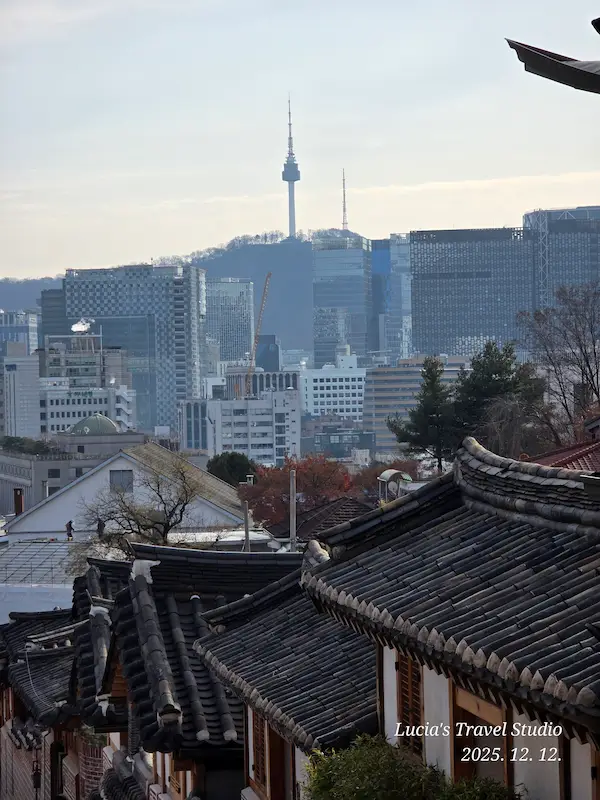
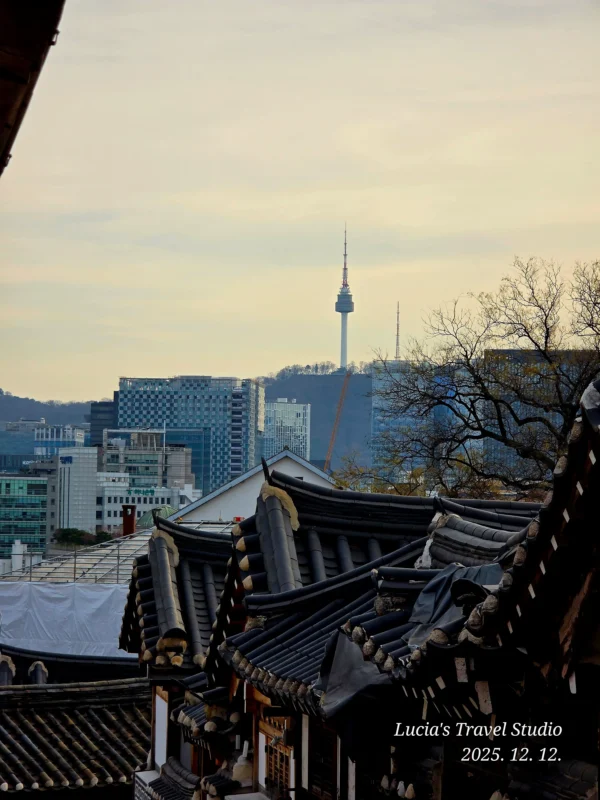
As I climbed higher, rows of beautiful hanok appeared one after another.
Between rooftops, I caught glimpses of Gyeongbokgung Palace, and beyond it, the ridgeline of Bukhansan.


An old guesthouse with a preserved public bath chimney stood out — details like this feel completely natural in Bukchon.
Wandering uphill toward the northeast, I eventually reached one of Bukchon’s most famous photo spots.
Suddenly, the crowd grew thicker, and colorful hanbok blended beautifully with the surrounding scenery.


🏛 Bukchon Art Museum
🏞️ Outdoor Highlights of Bukchon Art Museum
Located at the highest point of Bukchon, the Bukchon Art Museum stands on the former residential site of Maeng Sa-seong (맹사성, 1360–1438), a prime minister during the reign of King Sejong of the Joseon Dynasty.
The museum is best known for its panoramic viewpoint, offering sweeping views of the old Seoul city walls, the inner mountains of Seoul, and Gyeongbokgung Palace all at once—making it one of the most scenic spots in Bukchon.


The outdoor grounds feel more like a quiet garden than a museum courtyard, with ponds, seasonal flowers, and traditional landscaping. Two inner gates, Chuwonmun and Gyeongyangmun, mark gentle transitions as visitors move through the space.
🏛️ Indoor Highlights of Bukchon Art Museum
Tea Culture Hall (Exhibition Halls 2 & 3) presents tea ware from Korea, China, Japan, and Tibet, alongside rotating exhibitions featuring stationery, calligraphy, and related objects.
Large windows open onto scenic views, making the space feel both educational and restful.


Across from the hanok café stands Gobulseodang (Exhibition Hall 1), named after Maeng Sa-seong’s pen name.
Inside, visitors can view antique furniture and wood-carved calligraphy, including works inspired by Ahn Jung-geun’s handwriting.


The path from the Bukchon Art Museum down to Gahoe-dong Catholic Church felt quietly unique and beautifully tucked away.


Gahoe-dong Catholic Church
Walking down Bukchon-ro 11-gil, I arrived at Gahoe-dong Catholic Church.
Though located in the heart of Bukchon, it felt calm and contemplative rather than touristy.
Rebuilt in 2014, the church blends hanok-style architecture at the entrance with modern design deeper inside.
Several courtyards guide visitors naturally through the space, and the rooftop Sky Courtyard offers peaceful views over Bukchon’s rooftops.


This area is historically significant — in 1795, Father Zhou Wenmo (James Zhou) celebrated the first Catholic Mass on Korean soil nearby.
During times of persecution, believers quietly continued their faith in surrounding hanok homes.
Inside the church is a small historical exhibition space, displaying early Catholic materials such as Matteo Ricci’s Cheonju Silok, early hymn books, and mass manuals.
The display is modest, but deeply moving — a quiet reminder that this place holds layers of time.


Bukchon-ro 12-gil, just across from Gahoe-dong Catholic Church, is a lesser-known street — calm, unhurried, and quietly beautiful.


Bukchon Afternoon Walk
👘 Bukchon Hanokcheong
Crossing the street from the church and walking uphill, I reached Bukchon Hanokcheong.
The hanok space was hosting a beautiful hanbok exhibition, blending traditional lines and colors with contemporary design.


Seeing hanbok displayed within a hanok felt different from a museum setting —
quiet, intimate, and best appreciated in person.
Bukchon Afternoon Walk
🌇 Back West → Gwanghwamun
From there, I crossed Bukchon-ro again, passed the Constitutional Court, and headed west.
Soon, the National Museum of Modern and Contemporary Art (MMCA Seoul), National Folk Museum, Gyeongbokgung Palace and Dongshipjagak Pavillion.


Passing Dongshipjagak, the walk naturally led into the Gwanghwamun festival around 5 p.m.
☕ Closing Thoughts
A calm afternoon — not crowded, not rushed.
Just soft voices, sunlight on rooftops, and people lingering over coffee.


Bukchon remains a place that reveals itself only when you slow down and walk gently.
Quiet, understated, and deeply rewarding.
Bukchon Afternoon Walk
✨Next Destinations
Bukchon in the afternoon, then on to the lights of Gwanghwamun and Cheonggyecheon ✨ — a gentle close to a winter day in Seoul.
🌟 Seoul Light Gwanghwamun 2025 → A Magical Winter Night At Gwanghwamun: Christmas Market & Lights — Seoul Light Gwanghwamun 2025
🏮 Seoul Lantern Festival 2025 at Cheonggyecheon → Seoul Lantern Festival 2025 At Cheonggyecheon Stream — A Magical Winter Night Walk In Seoul
🌟 Private Tours to Explore Bukchon & Northern Seoul
If you prefer a guided experience or want to make your Bukchon walking tour even smoother, here are the best-rated private and small-group tours from Klook and GetYourGuide.
Klook – Best Bukchon & Northern Seoul Tours
🔹 Seoul Oraegage Bukchon Hanok Walking Tour
A deeper storytelling tour guided by experts who specialize in Bukchon’s architectural and historical heritage.
A compact route covering Bukchon, Gyeongbokgung and Gwangjang Market highlights — great for beginners.
🔹 Bukchon Hanbok Rental & Photoshoot (Hanboknam)
Perfect for taking traditional hanok photos around Bukchon and Gyeongbokgung.
GetYourGuide – Bukchon & Palace Experiences
🔹 Seoul: Bukchon Village Walking Tour
A curated walking route through Bukchon’s alleys, culture, and hidden viewpoints.
🔹 Time Travel in Seoul: Gyeongbokgung, Folk Museum & Bukchon
Explore Korea’s royal history with a guided palace walk + Bukchon heritage loop.
🔹 Seoul 2025: Gyeongbok Palace, Bukchon Village & Gwangjang Tour
Viator — Korean Highlight Tour with Hanbok & Tea Ceremony (2025).
🔹 Korean Highlight Tour with Hanbok & Tea Ceremony (2025)
A premium cultural package with traditional tea, hanbok fitting, and Bukchon stops.
💕 Affiliate Disclosure
Some links in this post are affiliate links. If you make a purchase through them, you won’t pay extra —but Lucia’s Travel Studio may earn a small commission.
Thank you for supporting my travel content! 💕