목차
ToggleKorea Entry Guide 2026: Everything You Need to Enter Korea Smoothly
This Korea Entry Guide 2026 explains everything foreign travelers need to know before entering South Korea—from visa requirements to K-ETA exemptions and the new e-Arrival Card system. While entry procedures may look complicated at first, preparing just once in advance can save you a great deal of time at the airport.
This Korea Entry Guide 2026 is a reliable, stress-free resource for travelers entering South Korea.
1. Countries That Require a Visa (Visa Required)
Nationals of countries that do not have a visa-free agreement with South Korea must obtain an appropriate visa before traveling, depending on the purpose of their visit.
● Tourism (Short-Term Stay)
The most common visa type is the C-3 (Short-Term Visit) Visa.
C-3-9 (General Tourism): For individual tourists
C-3-1 (Short-Term General): For attending events, visiting relatives, or similar purposes
Length of Stay:
Usually up to 90 days
How to Apply:
Apply in person at a Korean embassy or consulate in your home country
2. Countries That Do NOT Require a Visa (Visa-Free Entry)
Citizens of countries that have a visa waiver agreement with South Korea—or are unilaterally allowed visa-free entry (such as the U.S., Japan, Thailand, and around 100 other countries)—may enter Korea without a visa.
However, visa-free does not mean preparation-free. Depending on your nationality, the following may still be required.
① K-ETA (Korea Electronic Travel Authorization)
General Rule:
Travelers from visa-free countries are normally required to obtain K-ETA before boarding a flight to Korea.Temporary Exemption (Important):
To promote tourism, Korea has extended the temporary K-ETA exemption until December 31, 2026 for 67 countries listed below.
⚠️ Policies may change by nationality and year. Always double-check your country’s status before departure.Benefits of Having K-ETA:
Exemption from filling out the paper Arrival Card on the plane
How to Apply:
Official Korea Electronic Travel Authorization (K-ETA) website:
(operated by the Korea Immigration Service)
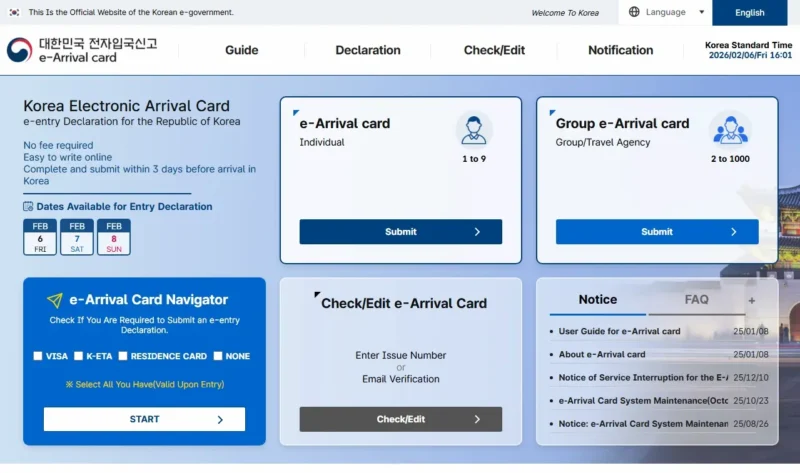
② e-Arrival Card (Electronic Arrival Declaration)
If you do not have K-ETA—either because you are exempt or chose not to apply—you must submit an Arrival Declaration.
You can still fill out a paper Arrival Card on the plane,
but submitting the e-Arrival Card online in advance allows for much faster immigration processing.
3. Korea Entry Guide 2026: Your First Step to Traveling Korea in 2026
Mastering K-ETA Exemptions & the e-Arrival Card (Korea Entry Guide 2026)

1) 📢 Extended K-ETA Temporary Exemption (Key Update)
The most important update is that the K-ETA exemption has been extended by one additional year, through the end of 2026.
a. Exemption Period
January 1, 2026 – December 31, 2026 (Korean Standard Time)
b. Key Points
Eligible Countries:
Countries already covered by the temporary exemption policyHow to Check Eligibility:
When applying for K-ETA, scanning your passport information page will trigger a popup confirming whether your nationality is exempt.Optional Application:
Even if exempt, travelers may still apply for K-ETA voluntarily to enjoy benefits such as skipping the arrival declaration.
(Application fees still apply.)
c. Additional Notes
Previously issued K-ETA approvals remain valid until their expiration date.
Fees for already issued K-ETA approvals are non-refundable.
📌 Full List of 67 K-ETA Exempt Countries
Asia (8):
Japan, Taiwan, Hong Kong, Singapore, Macau, Brunei, United Arab Emirates, Qatar
Americas (9):
United States (including Guam), Canada, Brazil, Mexico, Chile, Ecuador, Colombia, Peru, Bahamas
Europe (35):
United Kingdom, France, Germany, Italy, Netherlands, Spain, Switzerland, Sweden, Norway, Denmark, Belgium, Austria, Poland, Finland, Greece, Ireland, Portugal, Czech Republic, Hungary, Romania, Bulgaria, Cyprus, Estonia, Latvia, Lithuania, Luxembourg, Malta, Slovakia, Slovenia, Iceland, Liechtenstein, Croatia, Andorra, Monaco, San Marino
Oceania (2):
Australia, New Zealand
Others (13):
Israel, Saudi Arabia, Kuwait, Oman, Bahrain, Morocco, Tunisia, South Africa, and others
2) e-Arrival Card — Required Regardless of K-ETA Exemption
One of the most common questions is:
“If K-ETA is exempt, can I just land and go through immigration?”
The answer is No.
K-ETA is a pre-travel authorization
e-Arrival Card is an entry declaration
All foreign nationals entering Korea are subject to arrival declaration requirements.
Starting in 2026, all international airports in Korea are transitioning away from paper forms and adopting the e-Arrival Card as the standard.
Travelers from K-ETA-exempt countries do not need prior travel authorization
But they must still submit an arrival declaration before immigration
You may choose between paper and electronic forms, but the electronic version is strongly recommended.
How to Submit the e-Arrival Card
When:
From 3 days before arrival in KoreaWho Is Exempt from Submission:
Registered foreign residents in Korea (including permanent residents)
Travelers holding a valid K-ETA
Group tour visa holders (C-3-2 and certain group e-visas)
Transit visa-free passengers (B-2, 15D)
Airline crew members
You can also check eligibility using the e-Arrival Card Navigator on the official website.
3) Step-by-Step Guide for a Smooth Entry
24 hours before departure:
Visit the official Korea e-Arrival Card website
(Beware of imitation or scam websites.)Enter your information:
Passport details, flight number, accommodation address in Korea, and contact numberSave your QR code:
Take a screenshot. In-flight internet access may be unavailable.Arrival in Korea:
Present your passport and QR code at immigration.
Processing often takes less than one minute.
📞 e-Arrival Card Contact Information
Email: earrivalcard@korea.kr
(Korean & English support)Immigration Contact Center:
Within Korea: 1345
Overseas: +82-2-1345 / +82-2-6908-1345~6
Hours: Weekdays 09:00–22:00
(Evenings: Korean, English, Chinese only)
Lucia’s Thoughtful Tips 💡
Already have K-ETA?
If your K-ETA is still valid, you do not need to submit an e-Arrival Card separately. K-ETA holders are automatically exempt from arrival declarations.Save everything offline:
Airport Wi-Fi can be unreliable. Save screenshots of your QR code and booking details. Carry a power bank.Use detailed addresses:
Korea uses both road-name and lot-number addresses. Save both English and Korean versions of your accommodation address.
If staying at an Airbnb, ask your host in advance.Health Declaration (Q-CODE):
Separate from immigration, completing Q-CODE for quarantine screening is recommended. Many systems are integrated, allowing you to complete both at once.
Korea Entry Guide 2026 for visas, K-ETA exemptions, and e-Arrival Card requirements.
Conclusion
With this Korea Entry Guide 2026, you can prepare once and enter Korea with confidence.
Once you’ve prepared using Lucia’s guide, all that’s left is to relax and enjoy the view of Yeongjong Island from the AREX train window.
Welcome to Korea!!
Just arrived in Korea?
Make your journey easier with the right travel card.
👉 Read the complete Korea Travel Cards Guide here: Korea Travel Cards 2026 — Complete Guide To Korail Pass Plus, T-money, WOWPASS And More (Save Money While Traveling Korea)