Tongyeong Travel Guide 1: A Timeless Coastal City of Heroes, Art, and Living History
This post is the fourth entry in my six-day winter journey through Gyeongnam and Gyeongbuk—a trip shaped by coastal landscapes, lived-in history, and a slower, more reflective rhythm of
Start of the journey — Sancheong
Namhae (Entries 2–3)
Before Reading this Tongyeong Travel Guide
Before you dive in, be sure to download Naver Map — Korea’s most reliable navigation app.
It provides accurate walking, driving, and public transportation directions in English, making your travels easier and more enjoyable.
🌊 1. Tongyeong Travel Guide – Tongyeong, Shaped by the Sea
The Naples of the Orient
Tongyeong is more than a coastal city. It is a place shaped—patiently and beautifully—by the sea itself.
Blessed with dramatic natural scenery, Tongyeong has long been called “the Naples of the Orient.”

Its coastline curves gently in and out, forming a classic ria landscape—deep, winding inlets shaped by drowned river valleys, where headlands and bays alternate in endless rhythm.
More than 150 small islands scatter across the water like quiet punctuation marks, and between rocky inlets, small pocket beaches appear—
intimate, sheltered, almost private.

Even the city’s name reflects its history. Tongyeong (統營) comes from the 삼도수군통제영 (Samdo Sugun Tongjeyeong),
the supreme naval headquarters once commanded the fleets of three provinces (Chungcheong, Gyeongsang, and Jeolla Provinces) during the Joseon Dynasty.
From its very name, Tongyeong reveals what it was meant to be: a city entrusted with guarding the sea.

Today, history softens into warmth. The city’s beloved mascot Dongbaegi, inspired by camellia flowers and seagulls,
greets visitors throughout town—adding a gentle, human touch to a place shaped by duty.

✍️ 2. A City That Nurtured Art and Literature
Where Inspiration Quietly Takes Root
Tongyeong’s sea is not loud.
It does not demand attention.
Instead, it stays—calm, constant—and that quiet presence has inspired generations of artists.

The city is the hometown of some of Korea’s most influential literary figures.
박경리 (Park Kyongni), author of the monumental epic Land,
drew deeply from Tongyeong’s landscapes and memories.
The hills of Seopi-rang and the area around Myeongjeong Spring echo softly through her work.



유치환(Yu Chi-hwan), known by his pen name Cheongma,
left his poetry scattered across the city.
Places like the old Jungang-dong post office—featured in his poem Happiness—
remain part of Tongyeong’s everyday scenery.


Art in Tongyeong extends beyond words.
During wartime, artisans gathered here in what were known as the Twelve Workshops, producing essential military supplies for the navy.
Their craftsmanship endured beyond the war, evolving into lacquerware, mother-of-pearl inlay, and fine crafts— forming the foundation of Tongyeong’s reputation as one of Korea’s most artistically rich cities.
⚓ 3. Gangguan Harbor
The City’s Living Room
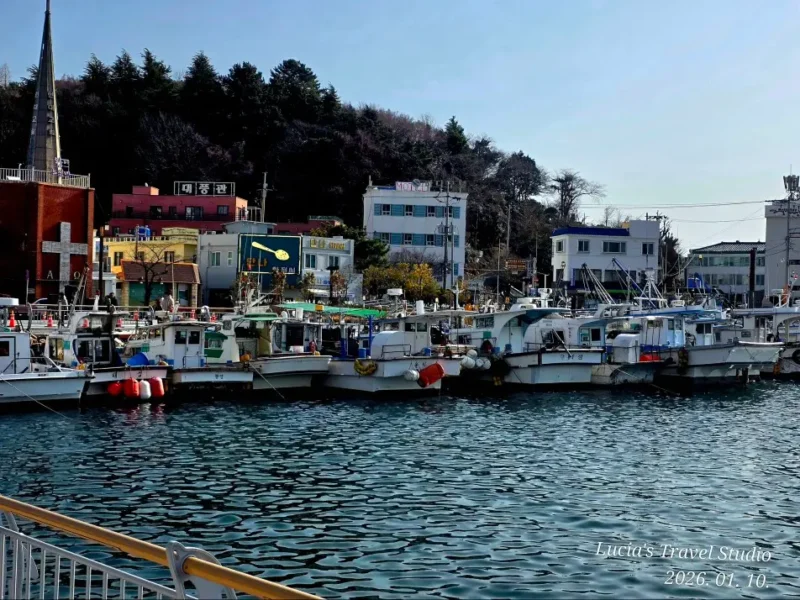
Gangguan Harbor is not merely a port. It is where Tongyeong’s streets, people, and time naturally come together.
For centuries, the city has lived and breathed around this water.


Rather than a harbor, Gangguan feels like a vast open-air living room.
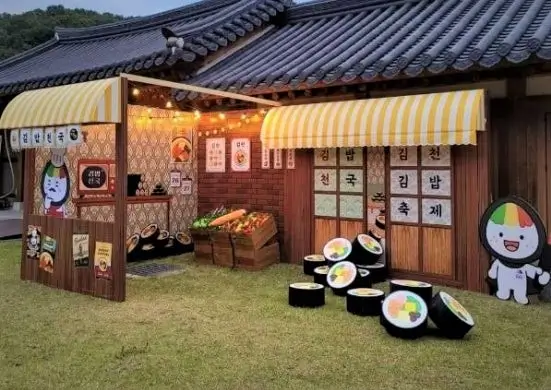
Walking along the harbor, you pass small restaurants serving Chungmu gimbap,
and the sweet scent of Tongyeong’s honey bread naturally slows your pace.


Food here is not a performance.
It is simply life, continuing as it always has.
Just beside the harbor, Jungang Market and Seoho Market stand side by side.
The voices of vendors in the early morning, the glimmer of freshly caught seafood— all confirm that Tongyeong is not frozen in history,
but very much alive.


🐢 4. Tongyeong, Admiral Yi Sun-sin, and the Turtle Ship
Tongyeong and Yi Sun-sin share a bond that feels almost fated.
This is not merely a place where battles once took place—
the very name Tongyeong itself originates from the admiral’s naval command.
1) A Fateful Encounter: The Battle of Hansan Island
When the Japanese invasions of Korea (Imjin War, 1592–1598) plunged the nation into crisis,
Admiral Yi achieved a decisive victory over the Japanese navy in the waters off Tongyeong, at Hansando.
This engagement is remembered as the Battle of Hansan Island.
His most formidable weapon in this battle was the Turtle Ship (Geobukseon).
After this victory, Joseon effectively secured control of the southern seas, disrupting enemy supply lines and marking a decisive turning point in the war.


2) The Birth of a City: The Origin of the Name “Tongyeong (統營)”
During the war, Admiral Yi established the Three Provinces Naval Headquarters, known as the Samdo Sugun Tongjeyeong, on Hansan Island to ensure efficient command of the navy.
Tongjeyeong (統制營) literally means “the headquarters that commands the naval forces of three provinces.”
Tongyeong (統營) is derived directly from this term, taking the first and last characters of Tongjeyeong.
In other words, Tongyeong itself was born as the admiral’s naval command center—a city whose identity is inseparable from his leadership.
3) Another Name You’ll See Everywhere: “Chungmu (忠武)”
While traveling through Tongyeong, you will often encounter names such as Chungmu Gimbap or Chungmu Bridge.
Chungmu (忠武) is the posthumous honorific title granted to Admiral Yi, meaning “Loyal and Martial.”
Out of deep respect for the admiral, Tongyeong was once officially named Chungmu City.
Although it later merged with Tongyeong County to become today’s Tongyeong City, the name Chungmu still blends into Tongyeong’s everyday landscape, quietly intact.
4) The Turtle Ship (Geobukseon) at Gangguan Harbor
At Gangguan Harbor, in front of Tongyeong’s central market,
full-scale reconstructed Joseon warships—including Turtle Ships and a Panokseon—are permanently docked.


These are not simple models. Visitors can step inside the vessels to experience the daily life and battle conditions of Joseon naval soldiers.
⚓ Visitor Information & Ship Lineup

Tongyeong Travel Guide
A total of four ships are moored side by side at Gangguan Harbor:
Three Turtle Ships
Tongjeyeong Turtle Ship
Jeolla Left Naval Headquarters Turtle Ship
Han River Turtle Ship
One Panokseon – the main battleship of the Joseon navy
Opening Hours
09:00–18:00 (Until 17:00 during winter, Closed every Monday)
Admission Fee
Adults: 2,000 KRW / Youth: 1,500 KRW / Children: 700 KRW /Free for Tongyeong residents
🔍 Highlights to Look For
The Turtle Ship: A Shock Assault Warship
Impenetrable Deck
Japanese naval tactics relied heavily on boarding enemy ships for close combat.
To counter this, the Turtle Ship’s rounded roof was embedded with sharp spikes and blades, making boarding virtually impossible.

Tongyeong Travel Guide
Psychological Warfare (Straw Covering)
During battle, the spikes were sometimes concealed with straw mats.
Enemy soldiers, mistaking the deck for an ordinary roof, would leap down—only to be impaled and immobilized.Complete Protection
Its enclosed structure shielded Joseon sailors from arrows and gunfire.

Tongyeong Travel Guide
Interior Experience
The ship spans two to three levels, recreating cooking and sleeping quarters.
Visitors can see cannons, try on naval uniforms, and examine the fearsome dragon head that once emitted smoke during battle.


The Panokseon: Backbone of the Joseon Navy

Tongyeong Travel Guide
If the turtle ship was a charging tank, the panokseon was the backbone— commanding the battlefield with powerful artillery. Together, they formed a complete naval strategy.
Two-Story Design
Larger than the Turtle Ship, the Panokseon separated rowers below from gunners and archers above, maximizing combat efficiency.Command Platform (Jangdae)
Climbing to the command deck offers one of the best panoramic views of Gangguan Harbor and downtown Tongyeong.Exhibitions
With a more spacious interior, the Panokseon displays Joseon naval weapons, daily rations, and shipbuilding techniques through detailed life-sized figures.


🏛️ 5. Samdo Sugun Tongjeyeong (Naval Headquarters) History Museum
Understanding the War Behind the Water
1) The Birth and Evolution of the Naval Headquarters


A History That Began with Yi Sun-sin
This section visually traces the history of the Tongjeyeong (Naval Headquarters)—from its first establishment on Hansan Island in 1593, through its relocation to present-day downtown Tongyeong after the Imjin War, until its official closure in 1895.
The Roots of a City
Visitors learn how the name Tongyeong originated from the headquarters itself, and how the Tongjeyeong once commanded and administered the seas of **three provinces—Gyeongsang, Jeolla, and Chungcheong—**serving as the strategic heart of Joseon’s naval defense.
2) Immersive Digital Exhibitions (Highlights)


Reconstructed Headquarters Model
Detailed scale models and visual media recreate the many government buildings of the naval headquarters, most of which no longer exist today.
Immersive Video Theater
Dramatic digital presentations depict key moments such as the Battle of Hansan Island, as well as scenes from everyday life at the naval headquarters.
These visuals are especially engaging for children and visitors with a strong interest in history.
Interactive Experiences
Through touch-screen displays, visitors can explore Joseon naval weapons, the structure of the Turtle Ship and Panokseon, and the daily lives of naval soldiers—making history both accessible and hands-on.
✨ Closing — A City That Was Defended
The sweetness of honey bread enjoyed by the harbor, the peaceful sight of yachts drifting on calm water—
all exist because this sea was once fiercely protected.
At Gangguan, the past and present float side by side.
Historic warships and modern boats share the same water without tension.
This harbor is where Tongyeong begins—
and where the city most honestly reveals the time it has endured.
If you’ve already seen Hansan: Rising Dragon on Netflix, this harbor may now feel different.
And if you haven’t—Tongyeong gives the story a quieter, more human scale.
🔗 Transition to Part 2
From the history that guarded the sea, our gaze now moves upward—to the hills of Dongpirang and Seopirang, and into Tongyeong’s everyday flavors: Chungmu gimbap, ggulppang (honey bread), and peanut bread.